Per-side, drawn out
Not a wall of text — the actual stack, biggest plate to smallest, in the order you'd slide them on. Glance and load.
Type the weight you want on the bar. See exactly which plates go on each side. Pounds or kilos, any bar, no arithmetic at 90 seconds of rest.
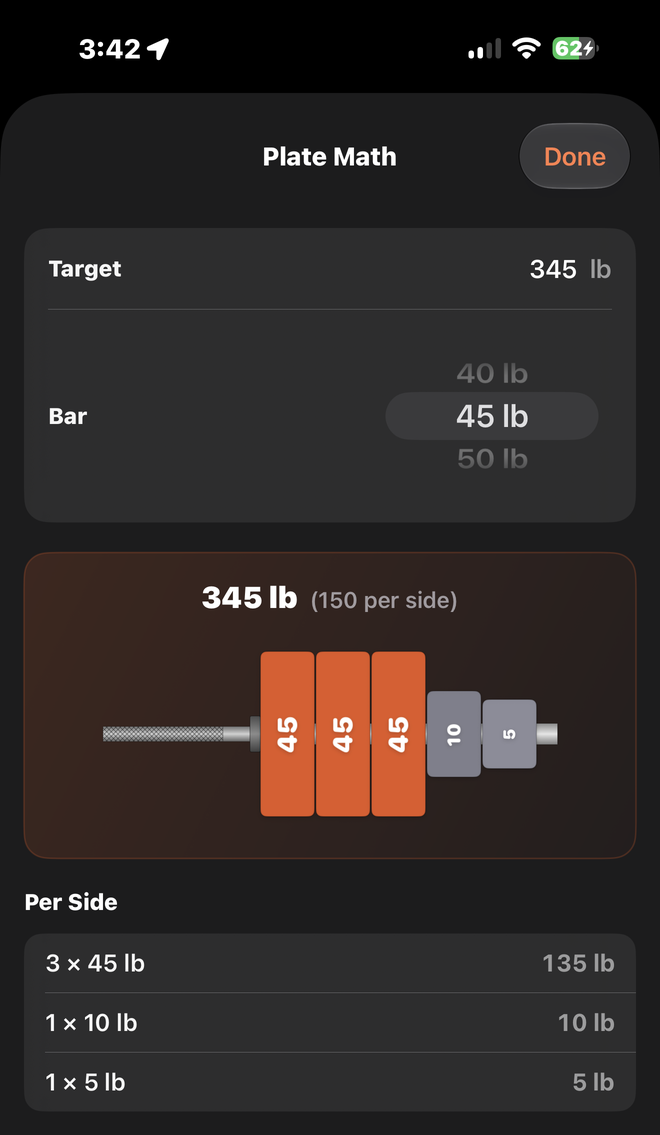
Type the weight. It draws the bar — biggest plate to smallest, in the order you'd actually slide them on — and lists the per-side breakdown underneath.
Ask for a weight the plates can't build and it tells you the closest one you can, instead of quietly rounding and letting you find out at the rack.
No sign-in, no setup, no ads between you and the answer. Open it, type a number, load the bar.
Not a wall of text — the actual stack, biggest plate to smallest, in the order you'd slide them on. Glance and load.
45 lb, 35 lb, a 20 kg women's bar, a 25 lb fixed bar for curls. Set the bar and the math follows it.
A kg lifter loads a 20 kg bar with 25s, 20s, 15s and 1.25s — real kilo plates, not pounds with a converted label stuck on.
Standard commercial-gym set:
Standard metric set:
This isn't a simplified web version. The calculator here is the exact code that runs on the workout screen inside Beyond Normal, so the plates it gives you match the plates the app gives you mid-session.
Plate math, the 1RM calculator and deadlift bar path are the first three. More are in progress, and they all land here — free, no install. Leave your email if you want to hear about them.
Only when there's something new to use. No newsletter, no drip sequence, no sharing your address. Unsubscribe in one click.
Inside Beyond Normal, plate math isn't something you open — every set on your workout screen already shows its own loadout, calculated from your training max. You look at the bar, not at a calculator. Plus 5/3/1 programming, PR tracking, Apple Watch, deadlift bar path, and a coach that reads your real numbers.