Your estimated 1RM
From any set between 1 and roughly 12 reps. Past that the math gets shaky and the app says so rather than quietly handing you a fantasy number.
You don't need to test a single to know. Give it a set you actually did — weight and reps — and get your estimated 1RM plus every training percentage you'd program off it.
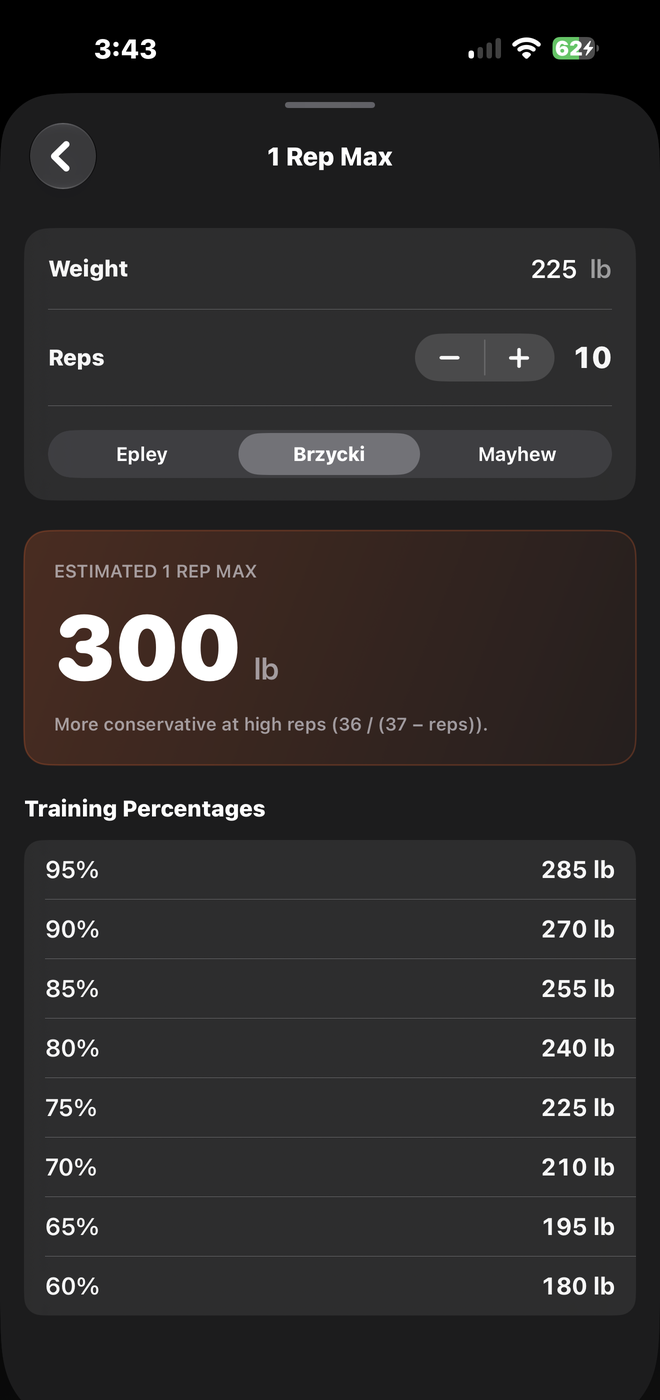
Most calculators stop at the number. This one keeps going and hands you the percentage table — because a max on its own doesn't tell you what to put on the bar on Monday.
Switch formulas and watch the estimate move. That disagreement is real information, not a rounding error.
The estimate, and the whole programming range worked out beneath it in your own units.
From any set between 1 and roughly 12 reps. Past that the math gets shaky and the app says so rather than quietly handing you a fantasy number.
95, 90, 85, 80, 75, 70, 65 and 60 percent, worked out in your units. The whole programming range in one glance.
Rep-max formulas are models, not measurements. They diverge most exactly where lifters use them most — the high-rep AMRAP set. Pick the one that matches how you actually train instead of accepting whatever a calculator picked for you.
weight × (1 + reps ÷ 30)
The simple, widely used linear estimate. The default, and the one most lifting charts are built on.
weight × (36 ÷ (37 − reps))
More conservative once the reps climb. If Epley's number feels generous after a set of ten, this is the sanity check.
Sigmoid model, bench-tested
Non-linear, and the most realistic of the three at higher rep counts.
Wendler's program doesn't run off your 1RM — it runs off a training max set at 90% of it, deliberately. That's the line on the percentage table to look at, and it's exactly what Beyond Normal builds your whole program from.
The 1RM calculator, plate math and deadlift bar path are the first three. More are in progress, and they all land here — free, no install. Leave your email if you want to hear about them.
Only when there's something new to use. No newsletter, no drip sequence, no sharing your address. Unsubscribe in one click.
Beyond Normal starts exactly here: tell it a max, or a recent set, and it builds your 5/3/1 program and shows you your first working set with the plates already counted. It never shows you a number you didn't give it. Then it tracks every cycle, catches every PR, and grades every session.