Did you actually go to failure?
If your bar speed barely drops across the set, you stopped early — and your training max is about to move on a number that wasn't real. If it falls off a cliff, you emptied the tank and the PR is honest.
Film one set with the phone already in your gym bag. Get your bar path, your speed on every rep, and the number that tells you whether you actually left it all out there. Deadlift, squat and bench.
Orange traces the path the bar actually took. The readout in the corner counts the rep, times the pull, and measures how far the bar strayed from vertical — burned into your own footage.
No wearable on the sleeve. No sensor on the bar. A phone leaned against whatever was handy, filming from the side.
Every one of these is computed on your phone from the frames themselves. No wearable on the bar, no sensor clipped to the sleeve, no account.
Each rep found and timed automatically, so the set is broken down one rep at a time.
Average concentric velocity across the set — how fast the bar actually moved on the way up.
How much slower the set finished than it started. The clearest signal of how deep into the tank you went — and this one says not very.
How far the bar wandered from a straight line, per rep and at its worst.
Those are the real numbers from the set below — not a mockup.
Every velocity product says “accurate.” None of them publish what that means. So we dropped a loaded barbell fifteen times and measured gravity with the same code that will measure your set — because gravity is the one number whose right answer you already know.
Combined standard uncertainty across fifteen measurements. The target was 2%, set before any data existed.
With no correction of any kind applied. It reproduces to ±0.46%, which makes it a property of the setup rather than the method.
Loss is a ratio measured through one ruler, so a constant offset divides out exactly — it cannot reach the number above.
The full report is public, including the parts that went badly: nine defects found and fixed, a hypothesis that failed its own test, and a clause listing what we still haven’t established.
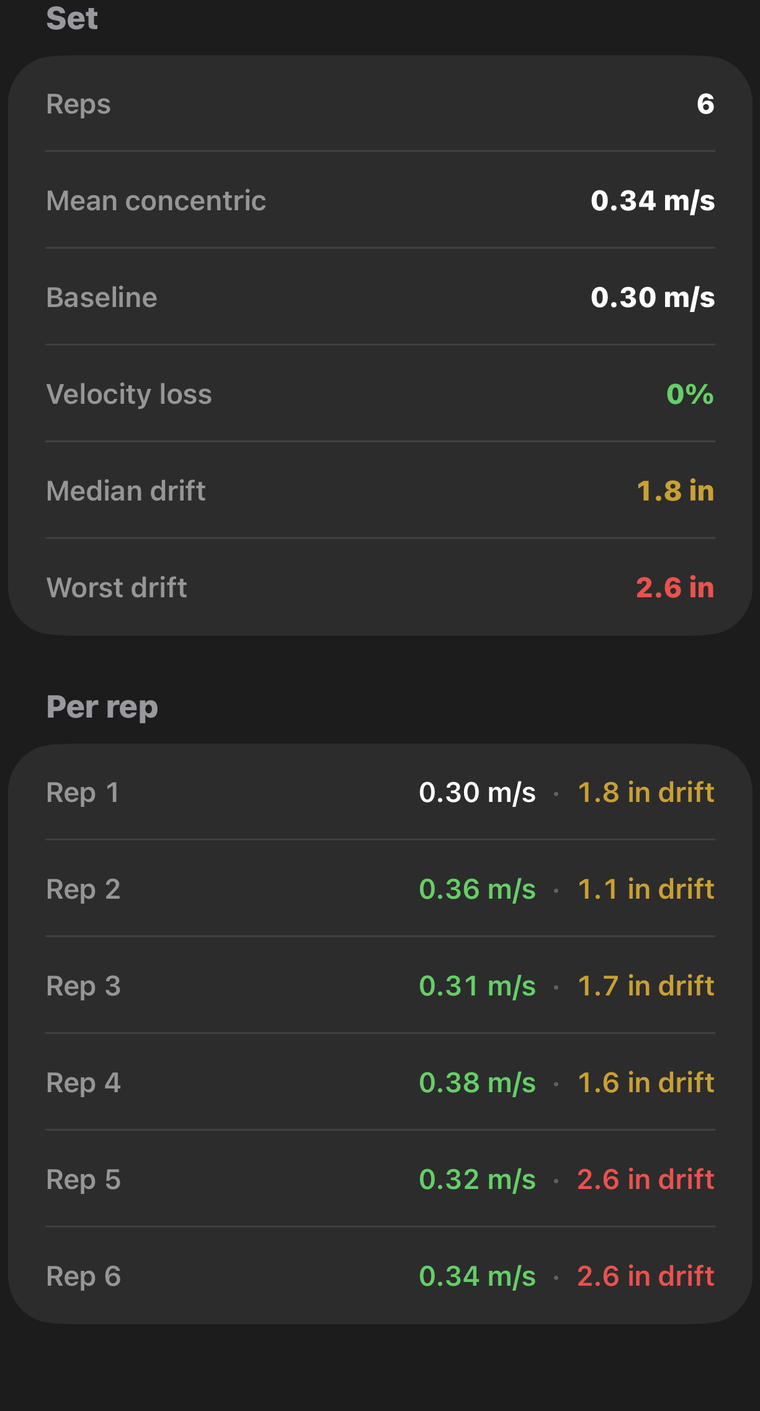
Speed and drift for all six reps, coloured so the bad ones find you. Reps 5 and 6 drifted past two and a half inches. Rep 2 was the straightest bar in the set at 1.1.
And look at the headline: 0% velocity loss. The last rep was as fast as the first, which means this set was nowhere near failure — and that is exactly the thing you cannot feel reliably and cannot reconstruct afterwards from the log.
Everything else in 5/3/1 is prescribed. Your last set is the exception — you decide when to rack it, and that decision drives your training max for the next cycle. Bar speed is the receipt. A set that ends at 15% velocity loss and a set that ends at 40% are two different sessions, no matter what you wrote in the log.
If your bar speed barely drops across the set, you stopped early — and your training max is about to move on a number that wasn't real. If it falls off a cliff, you emptied the tank and the PR is honest.
Drift shows the rep where the bar started wandering, and by how much. Not a coach's opinion — the actual path the bar took, traced from your own video.
Set the phone side-on. Lean it against a water bottle if you have to. Keep the whole plate, the bar, and the floor in frame for the entire set, and shoot somewhere reasonably lit. Side-on matters more than anything else — the tool measures a two-dimensional path, so an angled camera measures an angled path.
Film your top set. The heavy one taken near failure is the one worth measuring. That's where speed drops off and where form tends to come apart — a set of easy doubles won't tell you much.
Trim to your working reps. Drag the two markers so they cover the reps that count. Cut the walk-up, the setup, the chalk, and any failed rep at the end. Everything between the markers gets tracked, rep by rep.
The plan was to launch on the deadlift alone, because that is where rep detection was validated first. Squat and bench came in before submission instead, so all three ship together.
They took longer because each one is a different problem. A deadlift starts on the floor and a squat starts at the top, so the rep boundaries run in opposite directions. And a bench cannot be graded against a plumb line at all: the J-curve off the chest is correct technique, so measuring it as deviation from vertical marks good reps as bad. It needed its own model of what a good path looks like.
The whole analysis runs on your iPhone. Your video is never uploaded, never sent to a server, never seen by us — there's no account to attach it to in the first place. It's the same commitment the rest of the app makes: no analytics SDKs, no ad trackers, no third-party anything. Read the privacy policy if you want the long version.
Built, measured and submitted. Leave your email and you'll get one message the day it goes live — nothing else. Or tick the box and try it before then.
One email the day bar path ships. No newsletter, no drip sequence, no sharing your address. Unsubscribe in one click — which also takes you off the beta list.
The App Clip will measure one set and let it go. Beyond Normal keeps every set you film, tracks how your bar speed moves across a training cycle, and folds it into a full 5/3/1 program — training max progression, plate math, PR tracking, Apple Watch, and a coach that reads your actual numbers.